

What We Are Doing
Church Land
We are currently challenging ourselves to work towards the UN goal of conserving 30% land by 2030. In 2023 we assessed that 10% of our church property was ‘conserved’ which we are defining as protected and shared natural space with other species. In 2022, thanks to garden expansion efforts and a Garden for Wildlife™ checklist used by our kids, we became both a Certified Wildlife Habitat and Sacred Grounds site through the National Wildlife Federation. Sacred Grounds™ is a program that recognizes congregations, houses of worship and faith communities who both create wildlife habitat and actively link faith practices and caring for the environment. These certifications follow our engaging with an AMBS seminary student’s Church Land Theology project where we considered our relationship with church land.
Wild Church Network
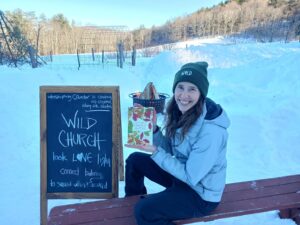 We officially joined the Wild Church Network as a member congregation in summer of 2020. We meet monthly as Wild Church to supplement our regular Sunday worship services.
At the June 2024 Wild Church Network’s Sacred Conversations retreat in Paris, Ontario Heather led a workshop on Wild Church Kids. Here is the handout she created as a take-away.
We contributed to a new book launched March 4, 2025! Field Guide to Church of the Wild includes stories and practices collected from Wild Church pioneers. That’s us! We have 9 entries in this collaborative resource.
Greening our Building
We went solar in 2016, intentionally overbuilding our array so that we could donate clean energy to Bethany Birches Camp. Thanks in part to a matching grant from Interfaith Power & Light, in 2019 we insulated our church building, an old school house on the historic building registry.
Permaculture Gardening
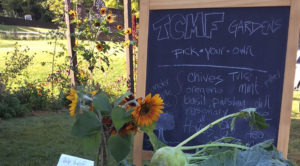 Inspired by a local church who created a how-to video, “Permaculture: Transform Your Church Lawn into a Garden of Eden”, in 2107 we established 4 no-till, edible forest gardens on the church property (a shade garden, tea garden, apple guild, and blueberry patch). In 2022 we expanded our gardens to include a mini fruit and nut orchard, a fedge (food hedge) for wildlife and human sustenance, and a trinity peace garden. These demonstration gardens show permaculture practices and regenerative agriculture in action.
Green Cleaning
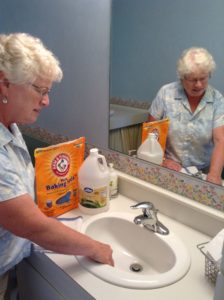 Members take turns weekly cleaning the church. We use homemade, green cleaners whenever we can. Primary products are baking powder and vinegar. Here are the recipes we use. Try them out in your own home. They are good for the environment and less expensive than commercial–a win-win!
For products we purchase, we look for eco-friendly options. Seventh Generation is a Vermont company that makes plant-based products. They are a B corporation, which means they are certified to be better for workers and better for the environment. B corps are concerned with people and the planet, not just profits.
Do you know what’s behind the name Seventh Generation?
The “7th generation” principle taught by Native Americans says that in every decision, be it personal, governmental or corporate, we must consider how it will affect our descendants seven generations into the future. (A generation is generally considered to be 25 years, so that’s 175 years.) This principle dates back to the Great Law of Peace of the Iroquois Nation, created in the 12th century: “In every deliberation, we must consider the impact on the seventh generation … even if it requires having skin as thick as the bark of a pine.”
Growing a Creation Care Section in our Church library
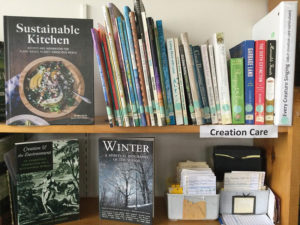 Here are some of the titles we’ve added recently:
- Creation and the Environment: An Anabaptist Perspective on a Sustainable World, edited by Calvin Redekop
- A variety of Wendell Berry’s books
- Great Possessions: An Amish Farmer’s Journal, by David Kline
- One Child, One Planet: Inspiration for the Young Conservationist, by Bridget McGovern Llewellyn
- Crinklecroot’s Guide to Giving Back to Nature, by Jim Arnosky (a Vermont author!)
- Every Creature Singing Curriculum (MCCN adult curriculum)
ZeroSort Recycling and Composting Food Scraps
 Here in Vermont we are blessed with law, infrastructure and community support around recycling. We moved to zero sort and have increased the amount and visibility of recycling collection bins while at the same time decreasing trash receptacles inside the church.
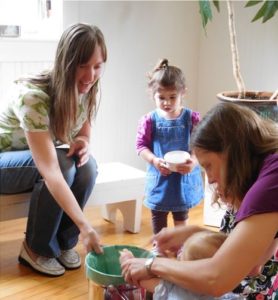
State law now requires that all food scraps are banned from landfills. We decided to be early adopters, adding a compost pail to our coffee time area for coffee filters, grounds and food scraps. Individual members take it home and add to their household compost piles right now as we do not have composting set up on site. Here is the pail we chose and have been happy with since debuting it in August 2016. With it we use 100% biodegradable, compostable liners to make clean up quick and easy.
Creation Care Bulletin Board
We have dedicated a bulletin board at the church for posting creation care related news, information and inspiration. Here is a prayer that was posted on the board at Thanksgiving time: Mikmaq Prayer for Thanksgiving.
Supported Ministries
Sustainable Kitchen: Recipes and Inspiration for Plant-based, Planet-conscious Meals by Jaynie McCloskey and Heather Wolfe (Herald Press, Sept 2020)
Cook more healthfully, Eat more sustainably, Live more faithfully. The first vegetarian cookbook published by Menno Media’s Herald Press. Watch the cookbook launch video: interview with authors
Check out Anabaptist World’s Faithful Living and Eating column that author Heather Wolfe contributes to for more recipes and inspiration
Health in Harmony
“Our Mission: Engage community-led solutions for human health and the health of our planet.” The founders, Cam and Kinari Webb, are past attendees of Taftsville Chapel. We have continued to support their ministry in our annual congregational giving.
Bethany Birches Camp (BBC)
We intentionally designed our solar array to generate more energy than we need and set up a group net metering account where we donate our excess renewable energy credits to BBC, whose core mission is to help young people to develop their relationship with God by providing them with a Christ-centered camping experience in a natural and nurturing environment. We are fortunate that our state of Vermont has favorable laws and supportive utilities that encourage and incentivize renewables.
Wild Church at Meadow View Farm
(see the ‘What we are doing‘ section and our quarterly newsletters)
Seminary of the Wild Earth
TCMF is financially supporting our creation care liaison to attend Seminary of the Wild Earth’s one-year eco-ministry program during the 2023-2024 year. She will be continuing on with their vocation year 2, an eco-spiritual direction certification program, ending with ordination in June 2025.